Thursday, October 15, 2020

Athena


My mother at the Erecheum, Athens, Greece, 1957.


The Erechtheion is an ancient Greek temple 

constructed on the acropolis of Athens 

between 421 and 406 BCE.


You did not inherit the throne

dear daughter—

no map-like memory

or language ability

no attributes of the Gods.

You are fallible, human,

whereas I don the grey gleaming

olive crown of Athens.


Modern thought? Wisdom? 

I embody them both.

I did not spring from my father’s head—

the birth was typical.


My family was marked by peculiar happenings

the ancient half dragon, half human creature

really an ordinary man,

and another forced into a pretend marriage.


My father drove an electric milk truck

on Brooklyn streets

so we did not want for anything.

My mother was plumber, cook, 

sewer of clothing until

she fell down on the sidewalk

cancer riddled.


I was already in college at age 16

when they tried to split us up

but I prevailed—my brother did not

go to cousins in Florida.


I’m called the goddess of war,

contested Poseidon for Attica.

I know how to battle

intimidation of a daughter a sacred art

shame in money issues a boon for my glory.


I taught you to read and showed

what I could of life

by example. 

I have worn armor, helmet,

and a shield showing two lions devouring a bull.


I did not abuse my power.

There, in Erechtheum—

you will find my statue

glorifying the city’s influence.


You will find me in the theater of Dionysius,

at the Parthenon,

or in my temple in Delphi.

Look in the marketplace of Athens for me—

I like handicrafts, weaving.

Look in the orchards

for fruits under my protection.


Olympus trembles terribly

under my bright eyes—

the earth groans sorely

the sea heaves in purple waves.

Monday, August 17, 2020

The Gong

We called our father’s camera “The Gong” because of the motion we’d make. Grab the object around his neck and watch it swing back to his chest. Make the sound “gong.” Like many games, this was one my brother invented, yet we were both annoying our father, complicit in the deed.

The picture taker in our family, he came to photography early on, before my brother and I knew him. Small square black and whites show Mom and Dad’s travels in England, where they lived from 1955-1957, and on travels through a Europe still emerging from World War II. Also documented were their thick long coats with many buttons, Mom’s plaid wool slacks, her flair skirt. In one Oxford picture, he photographs Mom as she faces him, sitting in a punt (row boat) while visiting there, her face widened by the shot so it looks completely round, accented by her bangs and short dark brown hair. In another, their London friends whom they knew from Mom’s Holborn library job and Dad’s work at the Surry mental hospital, peer unexpectedly at the camera, posed on a couch and chair. Later, one of the women, June, would respond to my letter apprising her of Mom’s death, that she and her husband had known Mom and Dad so many years ago when they were young, and communicated only by holiday cards.

For my parents, however, their time in England informed their lives. It was much more than still keeping in touch by holidays cards and about being young at the time. They were the ones on VISAS, they were the ones, as my father said in a letter to friends in the States, getting an education in the experience. Mom stood in front of Rome’s St. Peter’s cathedral, at the fountain. She sat in front of the Parthenon. Stood on a street in Yugoslavia during Tito’s rein. Dad occasionally posed in these photos when Mom took the picture. He has his hands in his pockets beside their car, the Austin Mini, surrounded by so much snow I wonder how they drove through Cheddar Gorge. They bought the car not only for their three month continental journey in 1956 and the two month trip in 1957, but also for their trips in England, and then sold it back.

Our father kept photography magazines in a special drawer in our Richmond house. Not a private place, the square wood telephone table stood in the hallways, available to anyone. To a child discovering a cover photo of a woman wearing a top but no bottom, what was I supposed to think? Her backside mostly faced the camera, her face turned around towards us. She had on a white blouse and a half apron, tied at the waist with cherries printed on it. Each of her butt cheeks was small, round, firm looking. Her expression, a partial smile, as if she knew something we didn’t. As I leafed through, I saw articles on photography, as promised by the name of the magazine, on how to get better pictures, and ads for equipment. Yet none of Dad’s photos looked that way, like the photo of the woman.

My father had a square jaw, and as he got older, his bottom lips became square in shape. He had a full shock of hair, brown turning white early, busy but not too thick eyebrows. He walked in a side-to-side manner, shuffling. His joints were operated on in his 50s and 60s—every finger by Dr. Pachietti, then two knee replacements later on. His handwriting, unreadable to everyone but Mom, his hands shaky, required Mom’s typing out letters for him despite her busy work life. She worked full time as a librarian and then as a medical records trauma coder. He had no secretary, either in private practice as an LCSW counseling couples and families, or as a contractor alternately with the Catholic Diocese of Oakland or the Jewish Family Service in Berkeley. I wonder if his shaky hands were the reason he took so long to take a picture.

His photography of family must have felt different than counseling nuns and priests or couples like the Bushbergs, who owned the Happy Cooker, a cookware store. Sitting or standing in a stationary position was key for both activities, counseling and photography; however, Dad could disappear behind the lense, while with counseling he had to steer and involve himself. None of us witnessed the client sessions, of course, but the fact that these people showed appreciation through gifts—a hand made glass lamp, a painting (both ending up in the family room/garage), and a sandwich named after Dad at one couple’s Los Gatos eatery, showed their appreciation. Further, clients shouted their neediness, calling our house, asking to talk to “Sam,” Dad’s work name. Mom called him Sol. In one case I talked down a suicidal woman. This evidence contrasted his closeness with clients as opposed to his family’s experience of him.

In our family, Dad was absentee. Even when he wasn’t on his regular schedule of late morning wake up and afternoon and evening clients appointments, he’d find ways to slip out. He had to drive further into Richmond to get a replacement part for his shaver. Al Lasher on University had electronics. We’d find McDonald’s napkins tucked in the glove compartment or see peaking out under the driver’s seat a crisp red and white stripe bag from McFarland’s over near the El Cerrito Place, the dry roasted and salted mixed nuts broadcasting his wanderings. But his wanderings took their toll. When Mom almost left the family due to Dad’s absenteeism, the concession was Dad taking us on Sunday drives. This didn’t necessarily provide more camera opportunities. The point of these family times were being together. We’d venture to the cheese company in Sonoma or another place within a two hour range and come back I the waning light, so even drifting off, I’d keep my eye on the blinking road dividers.

The “gong” was a Konika SLR film camera of the 1960s, solid metal, sometimes with a long lense attached, even better for the gong effect. The single-lense reflex camera, before the digital boom, used a mirror and prism system. When light was allowed to pass through the image could be captured. The Konika used a “roof pentaprism,” a system developed for the 1948 Duflex, patented in 1943 Hungary. The Japanese pentaprism SLR was born in 1955 with the Miranda T, followed by Pentax, Minolta, Zunow, Nikon, and Yashica. The Konica “Autoreflex” of 1965 used an external light meter. 

The action on a camera is deceptively simple, yet precise. However, the camera’s “holder,” the human taking the picture, needs to be still. The holder turns the focus ring, turns the film speed dial to set the ISO, then turns the shutter knob to the desired speech. Then he turns the aperture ring—this decides how far open the mirror will go. The hands move gently. With my father, the act of taking a photo prolonged minutes into what felt like hours. Not uncommon for SLRs, holders will stand (or sit) in one place until the shot is right—lighting, speed, everyone standing stock still. My brother was often a blur in family shots, unable to make himself into a temporary statue. Hyperactive they called it. Often my brother and I would conspire to make a face and hold our left arms up, curve the hand a bit. We called that the “Hah,” which came from a song we made up and sang on long car trips to a campground in summer. As much as our father tried to capture us looking normal, at the last minute we’d open our mouths, flash our upper teeth, and do “The Hah.” This would only cause our father to take another picture, messing it up for everyone. I never saw our father use a tripod, even when capturing a moose at the Snake River on our trip through Yellowstone and the Grand Tetons.

One picture taken which documents my father with the Gong around his neck was taken by a third party. The shot must have been sent to my parents by the taker. The background of the San Francisco Bay and cypress trees marks this as the Coit Tower viewing area, meaning a family or friend visit, showing visitors around the city. Judging from my mother’s red plush blazer, the visitors are Andre and Odilie from France. My mother’s big round sunglasses, wide shirt lapels, my father with his usual tan sport jacket, the camera strap thin black leather. The camera looks smaller than I remember it as a child. His gaze is set at some distant point, as is my mother’s. 

My father got control over his life the only way he knew how—errands and work were two. But with the camera, he also had control—over focus, light, settings. He got control in this way, while he couldn’t control what was happening with the family at home. My brother’s acting out, the loudness, yelling in the living room, and how one result was my father breaking my brother’s bedroom door with his foot because the door was locked. He also smashed some of my brother’s record albums. I played my part, teasing my brother until he beat my legs to bruises, and on long car trips our father reached around with one arm and grabbed my brother’s knee. “Stop, Mark,” he said, his Brooklyn accent treating the “A” vowel like “Mock” and without the “R” to soften the sound. With our father behind the camera, how much control did he have really? What do his pictures show? My brother and I do not comply. Others are more willing subjects. Not as many people used cameras in those days, and in many gatherings he was uniquely prepared to document. 

An action shot of my father with the camera was taken by me with my Instamatic camera during one of our family trips in the Monterey Bay Area. We had discovered the Asilomar conference grounds and State Park during the 1970s, on Dad’s first work conference there, where he brought us along. We frequented the place through the years aside on personal trips, struck by the natural beauty and historic, rustic buildings at the site, such as those by architects Julia Morgan and John Carl Warnecke. In this particular photo, he holds the Konika camera up to his right eye, hand on the front dial. His left eye is shut. You can see the left corner of his mouth in a grin. We must have been posing for him. The Instamatic camera had already been initiated at Girl Scout camp a few years earlier, when I accidentally dropped it down the “biffy,” or portable toilet, and somehow after fishing it out with the help of a counselor and a long pole rigged, it still worked. With this camera, I documented some of the same territory as my father, but from a different vantage point. 

This picture with him in his proverbial tan sport jacket, his full white head of hair, his square black framed glasses, is one of the few pictures of him with a camera, and the only one I have where he is in the act of using it. The object is not just a “gong” clanging against his chest—the action may be slow, like his car driving or walking, but it’s precise. He sees us through that lense. He watches, takes in the blur to focus, using the light to show who we are. 

Thursday, October 10, 2019

Each Time


The first time it happened 
I twisted my leg muscles
I rose from the chair
realized nothing
remembered nothing

Later I would say
I remember
I was reading Sylvia Plath’s poems
finished watching a movie about her
gazing at the cats on the sofa

The second time
I was reviewing the police report.
I did not need to see a doctor.
Gasps in logic
watching them carry the body
away like watching someone
you don’t know getting undressed.

At an age where I should be settled—
own a house, pay a mortgage,
though I wouldn’t have lived on a busy corner.

Worse than a 100 year old plant dying
worse than wondering if it would
ever bloom, hummingbirds pollinating it
on the small porch
white blooms.

Can one ever be satisfied?

Each time I tell people
eyes hungry, questions
“good detail” they burp
like trying on a girlfriend’s clothes
they run throiugh the scenario
and see if it fits.
I want to share
I don’t want to share

Each day clearing the bottom rooms—
kitchen, dining room, and how living room,
I hear the crash—
how much easier it would be now
with nothing in those rooms
to slow it down.

I think of the burger place on Cutting and San Pablo
the Black woman with a white hair net
her son helping out.
Next door the barber with a bobbing bird
in his window—
buildings one
or re-used
then gone.
We would push against the counter
to stand up.
Such a bargain.

Even now, inquiries.
Like my mother’s stroke and six months later
her death, it keeps coming—
different seasons but the same
nausea and unanticipation
no way of pressing a blade
closer, shiny, fixated
alone, a wimpering animal
against the cut.

All at once I felt a snap
and a rush and as if it were
100 below I was shaking.
I could hear my mother’s voice,
“put a sweater on” but I didn’t.
I was crying to live in those
moments, as if a door had slammed
or someone had locked me out
of life. Chest heaving,
my neighbor called—
“stay with me” I said
until I realized I couldn’t hold
the phone anymore.
What would I take?
The cats wouldn’t come into the carriers.

I emerged into the outside
of my skin, the street,
the house like a reptile
regurgitating its meal.
Sirens without noise,
red engine,
white pickup, 
crowd across the street
everything ready to explode
“stand back,” he said, as I filmed
two trucks pulling the criminal truck out of the house.

It would be a week until they bandaged
the house, wound gaping
but not repair it yet
even after a month.
First the abatement
“rip it out” then stabilize.
In a world of dead languages
the same worn phrases used
pain described of a structure taken apart.

A few people were crying, or at least
hands on their faces.
Go away I wanted to shout
and to the man who stepped in front
videoing, blocking me,
it’s me you are taking a part. 

My mind completely mixed up
like a puzzle—what’s first
like an argument about my own identity.
What stability means, in one
moment having to leave, skip to the next
chapter because the reading has been interrupted.

Not a Bomb


—after “Leap” by Brian Doyle

People heard it from a half mile away
down on San Pablo Avenue.
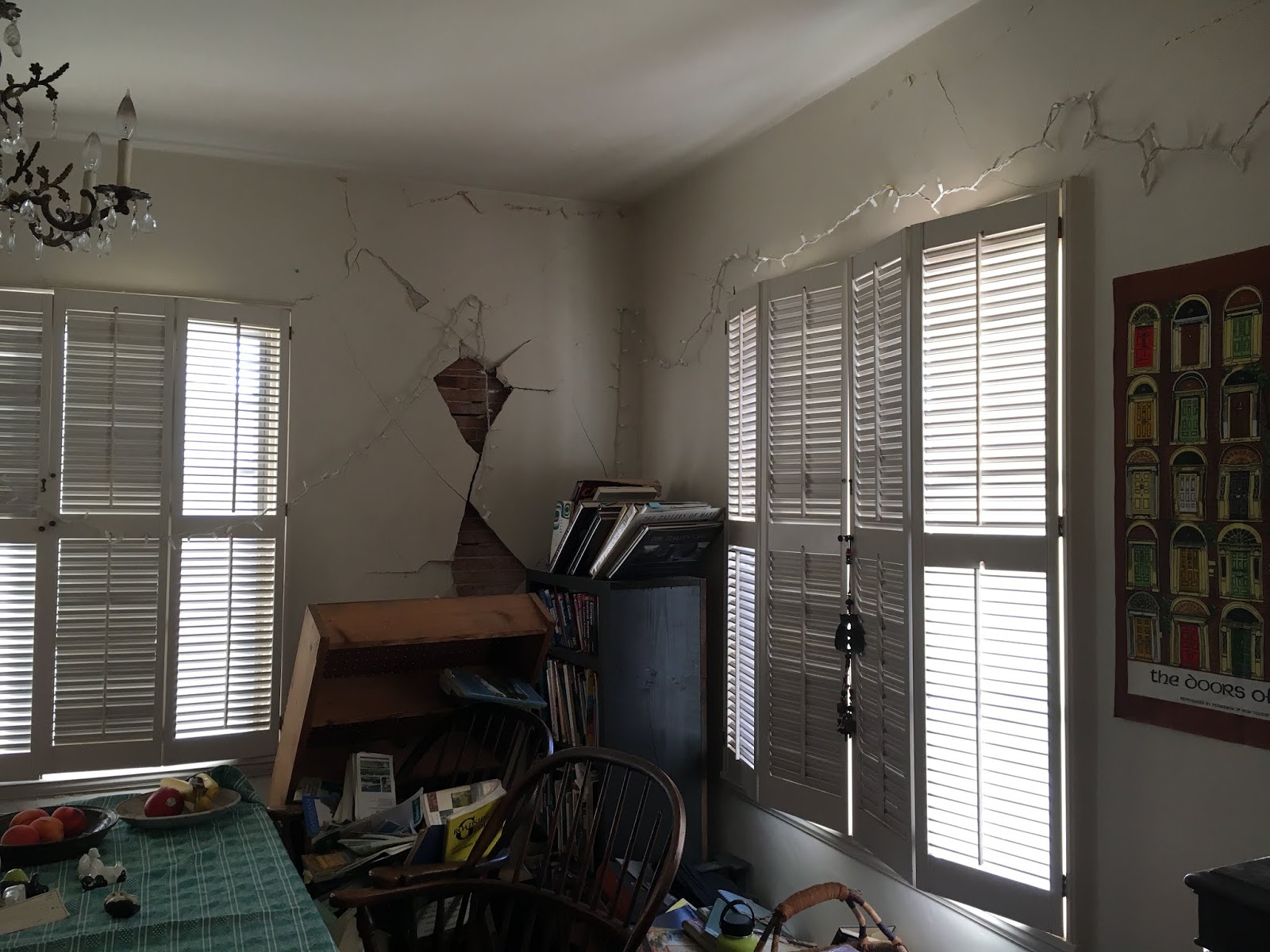
People heard it from across the street.
Yasmin texted her husband the construction worker
before calling 911 and reporting the accident.
Mr. Ayres’ son Mark rushed over with his fire extinguisher,
as did Liz, whose husband Steve was not home yet.
The new neighbors diagonally across the street 
came out of their house, saw the car plough through 
four cars at the intersection at 5 PM,
saw the pickup hit the house. Saw the fire,
wondered if someone was inside.

But there I am inside
sitting in the leather chair,
hearing almost crashes, skids outside

then
screech    crash    boom

then 
enter enter    louder louder
walls layer by later
pushed    pushing through
closer and more
closer and more    and louder

and it keeps coming and
no    no    no    no

the cats run upstairs
I stand up from the chair, leg muscle twists

Neighbor calls “don’t go out the front door,
there’s a fire” and I run upstairs
don’t see the cats, but close the door anyhow
grab my purse,
what else to take—laptop, oboe—
and I leave without it all.

Outside the house police and fire
a white pickup truck stuck in the bottom of the house.
Neighbor in front of her house talking to another neighbor,
across the street a dense population watches
like it’s a New York corner.
Cars dead in the intersection, a wooden sided trailer
in the middle, 

or did I see it pulled to the side? 
What happened first? 
What did Yasmin see from across the street?

I have to tell someone I am okay. The policeman says,
“In a minute. We’re taking statements from eye-witnesses.”

The fireman crawls under the house,
then he and PG&E go into the dining room, and I follow.
Shattered plaster walls, 
bookcases dumped like trash onto hardwoods

all the words out at the same time—
Adrienne Rich, Margaret Atwood, 
Trees of Northern America, East Bay Out,

maps from everywhere I went or wanted to go—
where did I want to go?
the “Bay Region” map AAA doesn’t make anymore
Mother’s pictoral map of Spain.

The Sachses’ dining room table and chairs untouched,
the jade and blue bowl by Kimmi Matsui cracked.

In the kitchen I see the linoleum floor buckled, pale dust
underneath, “asbestos” they say.
Plaster walls popping off, earthquake cracks made new
with a herringbone pattern as if someone took a razor and cut,

brown teapot on the floor. It was already broken.

People heard it from a half mile away.
But there I was inside, unable to think.

Days later, I will be told all objects need to be wiped before packing—
“don’t go in there”, don’t. You will get sick,
you will sue the owner. 
But the toxic report will not have come back yet.

One expert will comment “there are a few types of asbestos,”
and it becomes a pattern, like everyone’s estimate of the time it will take 
to put it all back together. 

And the boom keeps coming, as I box up wreckage.
Wreckage not because of being broken,
but because I can’t—

the scene is too new, too loud, and inspectors, engineers, and architects keep coming,
along with the Nashville musician chimney expert with his bright yellow truck.
They all prod and comment 

and just like that I’m back with my Mom in rehab,
then assisted living, then board and care, then the nursing home—
how people treated her as wallpaper, not as a person.
She was—

the same way here
as I go through belongings from devastation.

Neighbors walk by, don’t know the insides
don’t see my body tensing—
how my leg at the moment of the accident,
standing up from the chair, wrenching—
how my ears, ringing—

They don’t know how three years earlier, I couldn’t absorb the shock of Mom’s stroke,
the question in the ER that night, how they asked, “does she wear a diaper?”
how they saw my Mother
while to me she was fully competent—
what they saw—
she was invisible to them. 
As I am now. part of the wreckage.

This is not a flash of enlightened realization
I do not know where the story is heading,
the car tearing into the house a part of
my skin like a never return,
like a bomb.

Untie His Hands


In prison drawn
men in a circle
let him do to himself 
what he did to others.
How can we forgive,
like bees in a hive
working towards a common goal?

The day of the incident he wore an unfamiliar
brand of grease in his hair
slicked back, excess of moisture,
mouth an “O”, semi-permanent,
teeth slammed against the car bag
that saved his life, already bruises
on his forehead, shirt cut
left arm bare—
these photos in the police report—
more real than when I saw him cut out 
of the truck after he slammed into our house.

Not Latino but Italian it turns out,
Gino, father of two little ones
but in these photos
the white Honda that he hit crumbled
like a tub of toothpaste
at the intersection,
driver taken to the hospital
in serious condition—
no statement from her.

“I felt the side of his trailer,”
another driver stated,
“He was going 45 in a 25 zone” said another
and other—
through a red light, four way stop
photo of a woman in a gurney
photo of a fireman looking underneath the house
where foundation bent
where beam broke
where the fire started
and was put out by three neighbors.

Before he got in his car that day
did his wife froth eggs
in two swipes, did she
kiss him goodbye
or did she, years earlier
abandon his name,
move to Richmond.
No alcohol detected, no drugs, no
poison. Did he finish high school?
Did his father or mother come from Italy,
own a restaurant, a construction business?
Did he fall on hard times,
prepping his hand-made trailer
that morning, oversized construct
sailing behind him up the street, out of
alignment with the truck?

What kind of grease did he use in his car?
As they wheeled him out
his fingers, inert,
did not hold onto anything.
“Unconscious” said the police officer
like it happened every day, consequences
of his job, holding everyone’s gaze 
as if he were famous, 
but he was not the center of activity.

Dried blood on Gino the driver’s neck—
you have wrecked the house—
floors, walls, cabinets, chimney, underpinnings—
you have wrecked lives
exhausted your channels
like a stove, pipes. clogged.
I’m trying not to rely on heresay,
to stick to the official line
but the green tablecloth is patterned 
with lead paint and the bookcases are like mis-blown glass
in pieces on the floor.

The sound of grief in the morning,
I cannot put my finger on this winter
in late summer, cannot categorize the level
a hurricane of red within.

Some epiphany may arrive
from reckless abandon
walking down the hill to familiar lands.
I am not graceful
but make my way quickly and effortlessly
with my fists clenched.

I will not make promises,
shattered upon waking.
Your vehicle was not carrying mercy and salvation
at 5 PM on a weekday—
spirals make the evening
lives were saved.
I was not burned, not hit,
not killed by imprecise hands
through the stop light.
And I need no one’s permission to stay in this
ever-state. Some did not make their way home
from that day, noise a permanent marker—
some, like me were on the edge
are still on the edge,
almost gone.

Saturday, April 14, 2018

Setting in Fiction


Setting is where a story take place.

It can include the historical period, what the room looks like, or the town, or the outdoor environment. It is not static, but a living breathing quality of literature.

Questions to ask:
  • Does the reader need to know this?
  • What does it contribute to the story?
  • How does the writer make the setting essential to the action and the meaning of the story?


Setting Examples from two works of fiction. 
Notice the two different styles, and apply this to your reading for this week, in your reading response.


1. Maximalist Setting

Includes: Overflowing abundance of information and detail. Can seem gratuitous and excessive or richly evocative.

Work of fiction: Grand Ambition, novel by Lisa Michaels

Topic: Married couple Glen and Bessie embark on the first ever 1928 rapids boat trip down the Grand Canyon

“[Bessie] sat n the bare box springs in the center of the boat, while Glen stood on a cross plank, working the long sweeps. They were plowing through a caramel river—thick, with a greasy sheen. It ran flat and smooth to the banks, which were bare and just high enough to block the views on either side. A deep ditch, really. A canal. Within it, the boat looked rather substantial: a flat-bottomed barge the size of a peddler’s wagon, piled with supplies. A box stove, a .30-30 rifle, two cartons of bullets, crates of canned peaches and tomatoes and beans, rope and blankets. Bessie kept her things wrapped in oilskin: a box camera, twenty-seven dollars in a beaded purse—a sentimental object, frivolous for any occasion ahead—pencils, charcoal, a sketchbook, and blank diary.”

Details:

  • The river is greasy.
  • Practicality contrasts with frivolous purse.
  • Some items just useful enough to make them plausible without sentimental.
  • Every sentence provides key information.
  • The river, boat, and objects in the boat are almost characters too.
  • The river is antagonist, the boat is a protector.


2. Minimalist Setting

Includes: Just enough detail to give an impression.

Work of fiction: “Thailand” short story from the book “Thailand” by Haruki Murakami, 2000

“Together, they passed through Bangkok’s vulgar, noisy, polluted streets. The traffic crawled along, people cursed each other, and the sound of car horns tore through the atmosphere like an air-raid siren. Plus, there were elephants lumbering down the street—and not just one or two of them. What were elephants doing in a city like this? she asked Nimit.
‘Their owners bring them from the country,’ he explained. ‘They used to use them for logging, but there was not enough work for them to survive that way. They brought their animals to the city to make money doing tricks for tourists. Now there are far too many elephants here, and that makes things very difficult for the city people. Sometimes an elephant will panic and run amok. Just the other day, a great many automobiles were damaged that way. The police try to put a stop to it, of course, but they cannot confiscate the elephants from their keepers. There would be no place to put them if they did, and the cost of feeding them would be enormous. All they can do is leave them alone.’”

What Murakami does:

  • Only three sentences of description, and short ones.
  • Just enough to give an impression of the daily chaos of the streets and to introduce elephants so the character Nimit can tell us about their history.
  • Images of elephants resonates with themes of displacement, loneliness, and loss that runs through the story.
  • Description and details play a minor role.
  • Fable: meaning is conveyed almost entirely through action and dialogue.

When setting works well:
Character’s attitudes are as important as detail, and are intertwined.
Tone can equal a feeling in a good setting.
Desire and longing can be shown in the descriptive details.